Personal Space in a Biotherapy Session: Touch, Distance and Consent
A nonmedical guide to personal space during biotherapy: hands at a distance, touch only with permission, practical comfort, privacy and the freedom to stop.
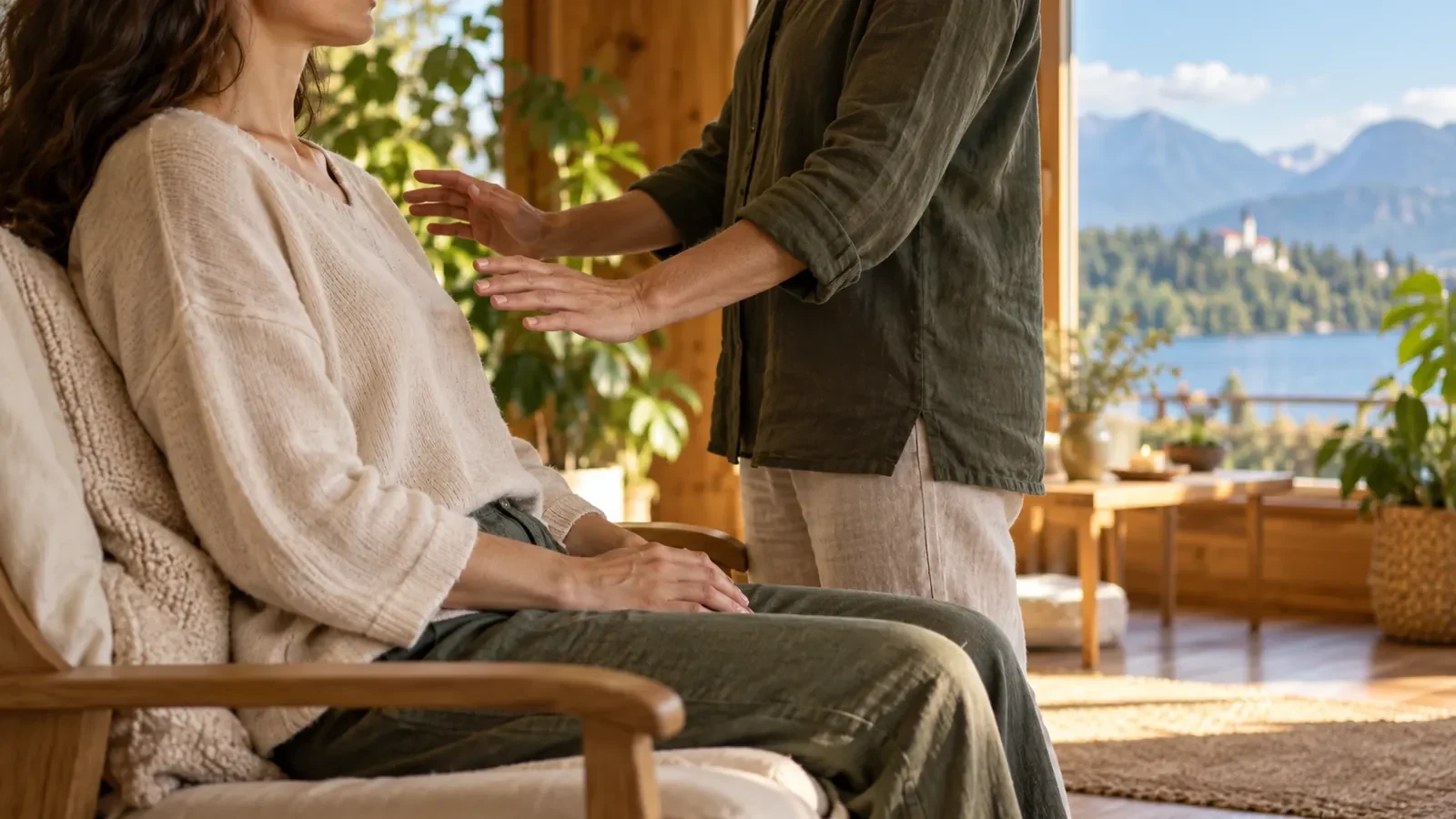
A biotherapy session can involve quiet sitting, a practitioner moving their hands near the body, conversation before and afterwards, or other steps described by the particular tradition. None of this should require a participant to surrender their personal space. The simplest standard is also the most useful: explain what is proposed, ask first, and make it easy to change or stop.
This guide concerns nonmedical biotherapy and wellness sessions, including practices taught within the Domančić Method. It describes respectful interaction rather than a diagnostic or treatment protocol. It does not assume that moving hands near a person measures an energy field or produces a medically established effect.
Agree on the format before the session
Ask the practitioner to describe the session in ordinary language. How long is it expected to last? Will you sit or lie down? Will the practitioner work with their hands at a distance, suggest any physical contact, or ask you to change position? May someone else be present?
A brief explanation helps prevent the participant from having to guess what is happening. The practitioner can also ask whether a chair, a little more space or a shorter session would make the person more comfortable.
Some questions are practical rather than personal. A participant might say, “I would prefer to remain seated,” or “Please explain before you move your hands closer.” Those are complete requests; there is no obligation to reveal private reasons.
A person may also choose not to continue. Agreeing to one aspect of a session does not mean agreeing to every later change.
Hands nearby are different from physical touch
In some biotherapy traditions, practitioners place or move their hands near the body without touching it. A participant can be comfortable with this and still prefer a particular distance. For another person, hands near the face or shoulders may feel too close. Neither preference is wrong.
Do not treat proximity as implied permission to touch. If physical contact is proposed, the practitioner should explain where and why it is proposed within the wellness activity and ask for clear permission beforehand. If the person declines, continue only in a format they have accepted, or end the session respectfully.
No one should be surprised by contact or asked to remove clothing for an ordinary nonmedical biotherapy session. There is no reason to insist on approaching intimate areas, and a participant should not feel obliged to tolerate an uncomfortable gesture to be considered cooperative.
Statements such as “the method only works if you let me” are not a substitute for permission or scientific evidence. An individual's bodily autonomy remains more important than a practitioner's customary routine.
Consent remains a conversation, not a one-time form
A short agreement at the beginning is helpful, but comfort may change during the session. The practitioner can check whether the position and distance remain acceptable, especially before changing what they are doing.
The participant should be able to say “a little farther away,” “I'd like a break,” or “please stop” without argument. Silence, politeness or nervous laughter should not automatically be interpreted as enthusiasm or permission.
A calm practitioner can acknowledge a request and adapt immediately. The aim is not to persuade the participant to endure an unwanted experience. A participant who prefers to watch or ask a question instead of taking part should also be respected.
For group demonstrations, this matters just as much. Our separate workshop observation guide discusses choosing whether to volunteer in an educational setting; an individual appointment requires the same attention to choice.
Make the environment fit the person
An ordinary nonclinical room can be suitable: comfortable seating, a reasonable temperature, drinking water and enough room to move. Some people prefer a chair with a backrest rather than lying down; others wish to keep a door ajar or have a companion nearby. Discuss any request that affects the room's safety or privacy in advance.
Sensory preferences matter too. Music, fragrances and a bright lamp may feel pleasant to one person and distracting to another. A practitioner should not assume that scented products, dim lighting or prolonged silence are necessary. Ask what would help the participant feel at ease.
A person with limited mobility should not have to force a posture to join a wellness activity. If the proposed format cannot be made comfortable, it is better to find an alternative than to push through pain or fatigue.
There is no required sensation or response
Someone might notice warmth, a sense of stillness, wandering attention, an emotion or nothing particular. These are descriptions of personal experience, not measurements of a clinical outcome. No one should be pressured to announce a sensation or to interpret it as evidence of a hidden condition.
Likewise, a practitioner should not claim that a participant's movement, expression or lack of a response establishes a diagnosis. Claims about particular mechanisms or health benefits need independently evaluated evidence. The US National Center for Complementary and Integrative Health recommends checking the evidence and safety of complementary approaches, rather than relying on testimonials alone.
A session may be meaningful as personal quiet time without any claim that biotherapy has corrected a medical problem. Participants remain free to describe their experience in their own words.
What to do if something feels wrong
Ask for the activity to stop. Move to a more comfortable position, request space, or leave. You do not need to justify a personal boundary in detail. A respectful practitioner should accept the decision without pressure, blame or predictions of harm for discontinuing.
If a misunderstanding occurs, a plain description is more useful than a debate: “I had agreed to hands at a distance, not physical contact.” An organiser can then address the practical issue. If conduct is inappropriate or your safety is threatened, seek appropriate local assistance.
New, severe or worsening physical or mental symptoms require appropriate professional assessment, not interpretation through a wellness session. Do not delay necessary care, stop prescribed treatment or treat a practitioner's impressions as a medical finding. NCCIH specifically cautions against replacing or postponing proven care with an unproven complementary approach.
Respect privacy before taking photos or notes
A practitioner may need ordinary scheduling and contact information, but collecting additional details should have a clear purpose. A personal photo is not automatically necessary for an in-person session. If photos, recordings or public testimonials are proposed, ask what will be collected, who will see it, why it is needed and how long it will be kept.
Under EU data-protection rules, individuals have rights concerning personal information held by organisations. The European Commission explains that organisations should provide clear information on their purposes and retention practices. Permission to participate in a wellness session is not a blanket agreement to publication or marketing use of someone's image.
Do not photograph other participants or share their experiences without appropriate permission. For a private appointment, it is reasonable to ask that the conversation remain private and that any optional record be minimal.
A simple ending is enough
At the end, the practitioner can ask whether the participant was comfortable and whether any part of the interaction should be changed next time. A reply might be “the chair was comfortable, but please keep more distance near my face.” It need not include a diagnosis, an energy score or a promised improvement.
If the session is remote, different logistical questions arise; see preparing for a remote biotherapy session. In either setting, ordinary respect, informed choice, realistic expectations and the freedom to stop are the foundation of a responsible nonmedical experience.
Personal space is not an obstacle to good practice. It is part of making the session understandable and genuinely voluntary.
Biotherapy is complementary support. It does not diagnose illness and does not replace medical advice, medication, examinations or emergency care.
Sources
- Are You Considering a Complementary Health Approach?
- Be an Informed Consumer
- Information for individuals – data protection rights