Inside a Biotherapy Workshop: Observation, Consent and Practical Learning
What a nonmedical biotherapy workshop can teach through observation, optional participation, privacy, practical questions and realistic expectations.
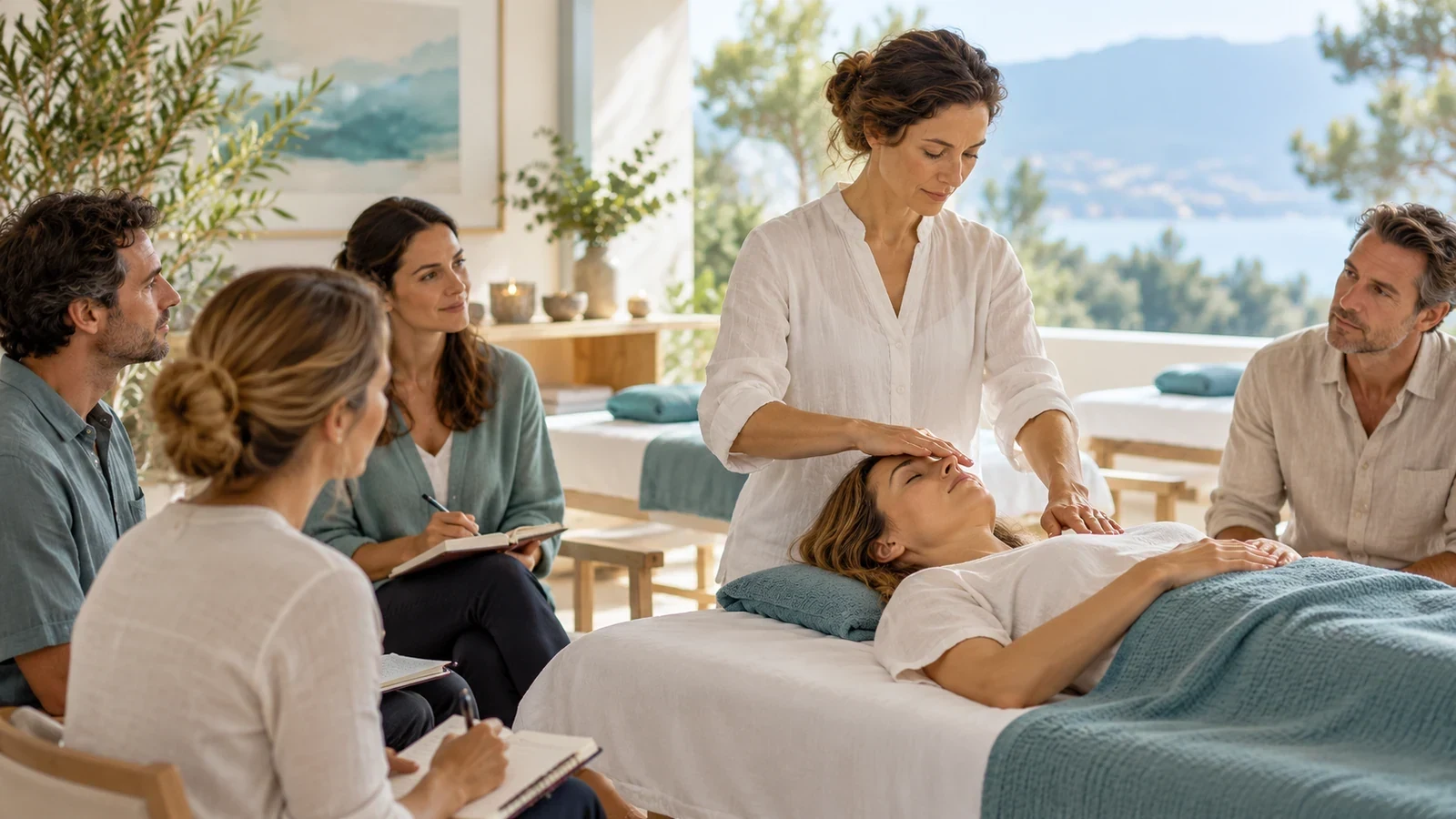
A biotherapy workshop is best understood as a place to learn, observe and ask questions about a complementary wellness practice. People may come because they are curious about the Domančić Method, want to understand how a session is organised, or hope to become more attentive when working with others. None of these purposes makes a workshop a healthcare qualification or establishes that the practice diagnoses or treats disease.
What should a thoughtful participant actually expect? A clear introduction, respectful observation, practical opportunities that are always optional, and room to question what is being taught. The most useful learning is often quieter than a dramatic demonstration.
Start with a clear description of the workshop
Before attending, look for a plain-language outline of what will happen. Is the event introductory, an observation day, or part of a longer educational programme? Will there be demonstrations, paired exercises, group discussion or time for questions? How much time will be spent sitting, standing or watching?
A good introduction also separates the workshop's learning objectives from health claims. For example, participants can learn how a facilitator explains a session, asks permission, creates a comfortable setting and observes a person's response. That is not the same as learning to diagnose an illness or proving that an energy-based intervention has a clinical effect.
The US National Center for Complementary and Integrative Health (NCCIH) recommends examining the evidence and safety of complementary approaches rather than relying on testimonials or advertising. Research on a particular approach must be considered on its own merits; positive findings for relaxation or another practice cannot automatically be transferred to biotherapy.
Observe the interaction, not just the technique
During a demonstration, pay attention to what happens before and after any hand movements. How does the facilitator describe the activity? Can the volunteer ask for more space? Is the room quiet enough for people to follow? Is there a clear way to stop?
You can also watch the pacing: an explanation, an invitation, the activity itself and a check-in afterwards. These details matter because they communicate respect and make the experience easier to understand.
Traditional biotherapy schools may describe particular hand positions or sensations using their own terminology. Such descriptions can be studied as part of the tradition without presenting them as medically established measurements. A person's warmth, calmness or tingling is an experience worth describing accurately, not proof that an underlying medical condition has changed.
Participation is a choice, not an obligation
You should be free to watch rather than volunteer. If a demonstration involves someone sitting or lying down, that person should know what is proposed and be able to refuse a position, movement or touch. Asking first is especially important when hands are placed near the face, shoulders or other personal areas.
The same principle applies to paired learning. One participant may prefer practice at a distance; another may opt out entirely. Neither choice needs justification. A responsible workshop does not pressure people to disclose a diagnosis, recount a personal experience, or demonstrate a particular emotional response.
A facilitator can make consent practical by explaining each activity in advance, checking again when it changes and allowing a pause without embarrassment. There should be no requirement to describe an uncomfortable sensation as a positive result.
A welcoming room does not need clinical staging
A workshop can take place in an ordinary, pleasant room with chairs, natural light, drinking water and enough space to move. Comfortable everyday clothing is appropriate. A demonstration area should provide privacy, modesty and easy access for anyone who wants to leave or rest.
If someone has mobility limitations or difficulty lying down, ask whether observation or a seated position is possible. Practical accessibility is more useful than insisting on a uniform posture. The aim is to create an understandable learning environment—not to imitate a hospital, examination room or professional medical service.
Notes, photography and other people's privacy
Taking notes about teaching points is different from recording a fellow participant. Avoid writing down names, health histories or identifying details that are not necessary for your own learning. Ask before taking a photograph or video, and do not assume that attending an event means agreeing to online publication.
The European Commission explains that where consent is the legal basis for personal-data processing, it must be freely given, specific, informed and unambiguous. Actual privacy obligations depend on the information collected and the applicable legal basis, so organisers should communicate their own policy rather than rely on a general statement at the start.
A useful notebook focuses on your questions: What was explained clearly? Which part would you like to observe again? What boundaries were agreed? What would help you feel more confident as a learner?
How to reflect without turning observations into proof
After a demonstration, participants may describe a range of impressions: relaxed, curious, distracted, more comfortable, or no noticeable change. It is reasonable to record these impressions in their own words. It is not reasonable to interpret them automatically as evidence of a cure, a diagnosis or a measurable change in an invisible field.
Different explanations—including expectation, ordinary rest, social attention and the setting—may contribute to how someone feels. A careful workshop welcomes honest reports, including “I did not notice anything.” It should not promise that everyone will have the same experience or that a single demonstration verifies effectiveness.
Questions worth taking home
Before leaving, consider whether you can explain the workshop's purpose to someone else without using exaggerated claims. You might ask the facilitator how further learning is structured, what counts as practical experience, how volunteers' privacy is protected and which situations are outside the practice's scope.
You can also ask how the organiser handles feedback, whether a learner can repeat an observation session and where published evidence can be independently checked. Good teaching should allow room for uncertainty and respectful disagreement.
Keep the boundaries clear afterwards
Biotherapy is offered as a complementary wellness practice, not a replacement for medical assessment, diagnosis or treatment. Workshop attendance does not qualify someone to make healthcare decisions for others. If you have an ongoing or new health concern, seek appropriate advice from a qualified health professional rather than delaying assessment on the basis of a workshop experience.
For readers exploring individual appointments rather than group learning, see preparing for a remote biotherapy session. For selecting a practitioner and discussing boundaries, read choosing a biotherapy practitioner.
A valuable workshop is one you can leave with clearer questions, a better understanding of consent and a more accurate description of what you observed. Curiosity and careful observation are enough; there is no need to claim more than the experience can support.
*Reviewed 30 October 2026. General educational information about a nonmedical wellness practice; not healthcare advice.*
Biotherapy is complementary support. It does not diagnose illness and does not replace medical advice, medication, examinations or emergency care.
Sources
- Are You Considering a Complementary Health Approach?
- Information for individuals – Consent in data protection
- Data protection notice for European Open Day 2025